
S-milestones
Developmental milestones and the enrichment of a smile
At around six weeks of age babies may begin to smile responsively in the presence of their primary caregiver. In turn, they (me) may (did) burst out crying at this milestone — happy tears, of course.
What is it about a smile that warms our hearts? Our beloved Prophet (peace be upon him) was known to smile more than anyone, alluding to his praiseworthy and seemingly inimitable trait of making everyone feel not only comfortable in his presence but like they are the most important person to him.
Making the person in front of us feel important and valued requires being physically, mentally, and emotionally present — phone down; mental to-do’s pushed aside; niggles of their past misdemeanours dismissed and replaced instead with a conscious focus on the good that exists — or could exist — within them.
Abdullah ibn al-Harith reported: I have not seen anyone smile more often than the Messenger of Allah (peace and blessings be upon him). (Tirmidhi)
This statement came from a companion who spent years with the Prophet during his life in Madinah and didn't just happen to catch him (peace be upon him) on a good day. His (peace be upon him) inner turmoil was obscured by an ever-cheerful countenance, enriching everyone who crossed his path with a feeling of ease.
Abu Huraira reported: The Messenger of Allah, peace and blessings be upon him, said, “Verily, you cannot enrich all of the people with your wealth, but rather you enrich them with your cheerful faces and good character.” (Shu’ab al-Iman 7567)
I’m blessed to know a few people with a naturally smiley disposition — crinkles of crows feet etch positivity into their face; their upturned mouth a daring invitation to resist mirroring the same. In their presence worries fleetingly take flight, the mundane seems remarkable, and everything feels a little less serious and a little more bearable.
“…The most beloved people to Allah are those who are most beneficial to people. The most beloved deed to Allah is to make a Muslim happy, or remove one of his troubles, or forgive his debt, or feed his hunger.” (Tabarani)
It’s no doubt that the monthly auto payments of sadaqah are invaluable. But they’re also convenient, easy and a one-time effort. They reach unknown faces in far away places leaving an impact we rarely get to see. On the other hand, making a concerted effort to smile at the faces we see everyday — those we live with and work with, who step on our toes and press our buttons — is the harder task, yet infinitely more rewarding both in the moment and in the hereafter.
Smiling at your brother is an act of sadaqah (charity). (Tirmidhi)
أَضْحَكَ اللَّهُ سِنَّكَ
May Allah keep you smiling. (Bukhari)
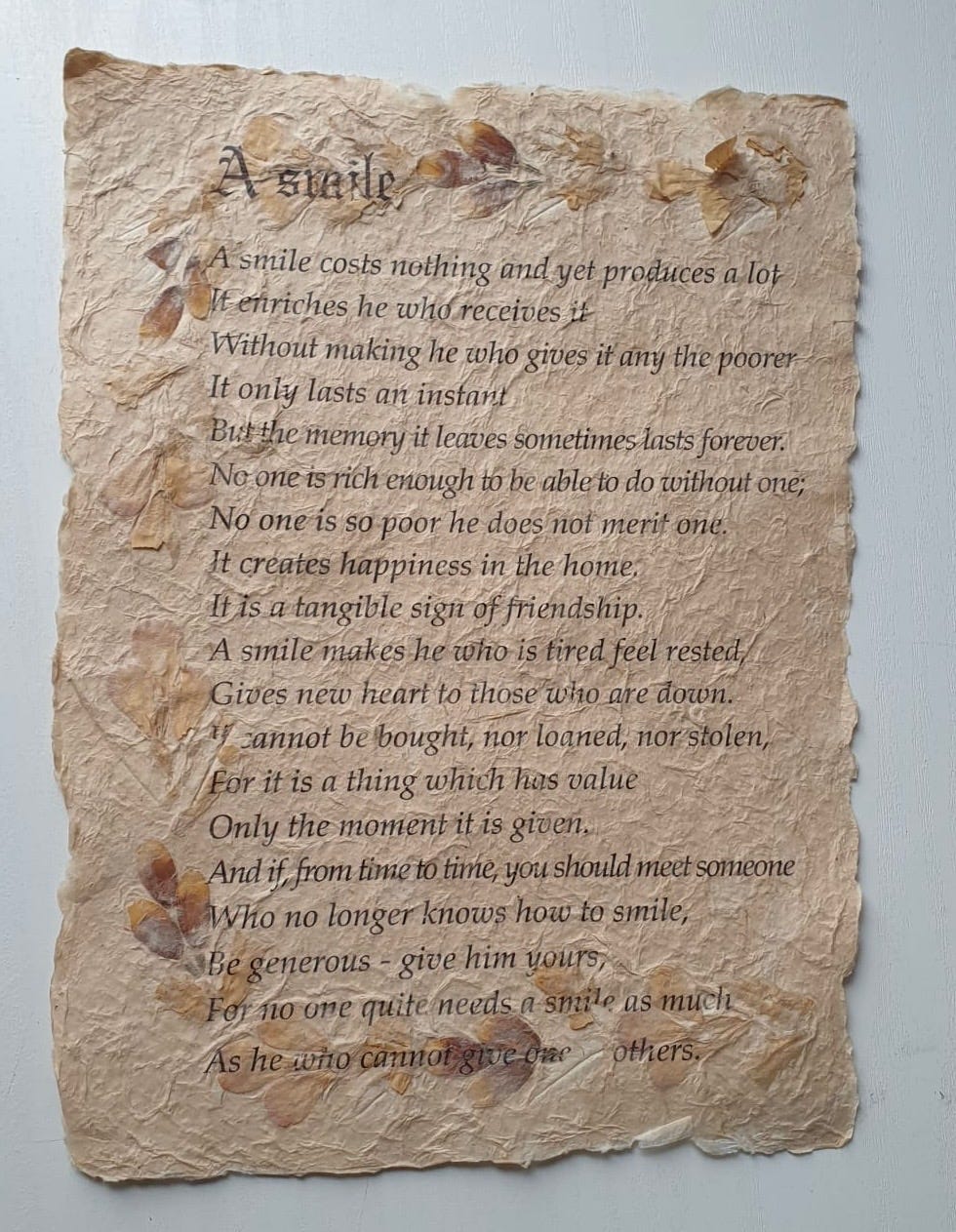
A smile costs nothing and yet produces a lot
It enriches he who receives it
Without making he who gives it any poorer
It only last instant
But the memory it leaves sometimes lasts forever.
No one is rich enough to be able to do without one;
No one is so poor he does not merit one.
It creates happiness in the home.
It is a tangible sign of friendship.
A smile makes he who is tired feel rested,
Gives new heart to those who are down.
It cannot be bought, nor loaned, nor stolen
For it is a thing which has value
Only the moment it is given.
And if from time to time you should meet someone
Who no longer knows how to smile
Be generous — give him yours.
No one quite needs a smile as much
As he who cannot give one to others.